
SEO Guide for Beginners: A Practical Roadmap to Better Search Visibility
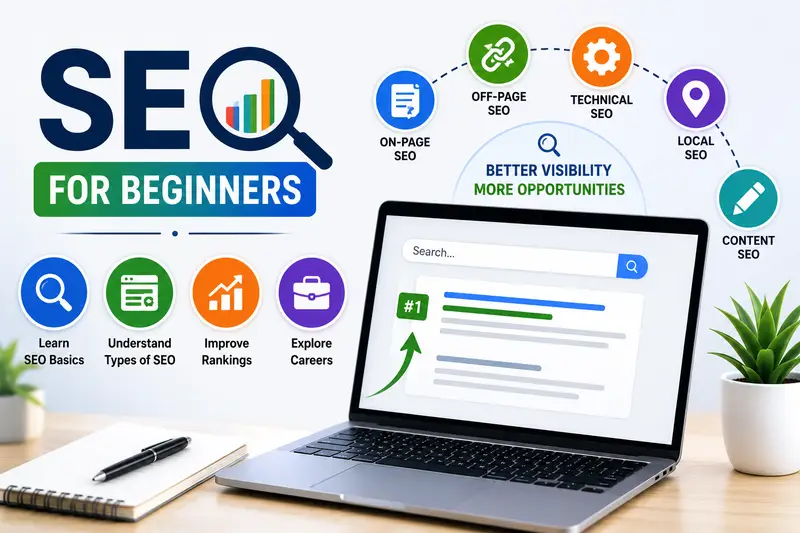
Photo by indmi.in
SEO Guide for Beginners: A Practical Roadmap to Better Search Visibility
For many businesses, the journey from being invisible online to attracting consistent customers begins with one question: How can people find my website on Google?
This is where Search Engine Optimization (SEO) becomes important. SEO is not simply about adding keywords to a webpage. It is a long-term business strategy that helps search engines understand your website while making your content more useful to potential customers.
Whether you run a startup, manage a small Indian business, work as a freelancer, or lead marketing for an established company, understanding SEO can help you generate relevant organic traffic without depending entirely on paid advertising.
The good news is that SEO does not have to be complicated. Once you understand how search engines discover, understand, and evaluate webpages, you can build a practical SEO strategy that supports visibility, credibility, leads, and long-term business growth.
What Is SEO?
Search Engine Optimization (SEO) is the process of improving a website and its content so that search engines can better discover, understand, and present its pages to people searching for relevant information, products, or services.
For example, imagine a business in Jaipur offering digital marketing services.
A potential customer searches:
“Best digital marketing agency for small businesses in Jaipur”
If the business has a well-optimized page addressing that specific need, it has a better opportunity to appear in relevant organic search results.
SEO generally involves:
- Keyword research
- Content optimization
- Technical SEO
- On-page SEO
- Internal linking
- Backlink development
- User experience
- Performance measurement
Google’s current Search Essentials emphasize helpful, reliable, people-first content, crawlable links, descriptive page elements, and compliance with search spam policies.
Why SEO Matters for Businesses
A strong SEO strategy can support several business objectives.
1. Generate Organic Traffic
Organic search can bring visitors without paying for every individual click.
2. Reach High-Intent Customers
Someone searching for “accounting software for small business” already has a specific need.
3. Build Brand Credibility
Appearing consistently for useful searches can strengthen brand awareness and trust.
4. Support Long-Term Growth
Unlike a short advertising campaign, useful SEO content can continue attracting visitors after publication.
5. Reduce Dependence on Paid Advertising
SEO and paid marketing work differently. A balanced strategy can use both rather than relying exclusively on one channel.
How Search Engines Work
Before learning SEO techniques, understand the basic process.
Search engines broadly work through three stages:
Crawling
Search engine systems discover webpages through links, sitemaps, and other signals.
Indexing
The search engine analyzes discovered pages and stores information about them in its index.
Ranking and Serving Results
When someone searches, the search engine determines which indexed pages are most relevant and useful for that query.
Therefore, SEO is not simply about “ranking higher.” Your website first needs to be discoverable, accessible, understandable, and valuable.
Step-by-Step SEO Guide for Beginners
Step 1: Define Your Target Audience
Start with your customers—not keywords.
Ask:
- Who are you trying to reach?
- What problems do they have?
- What products or services do they need?
- What questions do they search online?
- What location do they operate in?
For an Indian accounting consultancy, potential searches might include:
- GST accounting services
- accounting services for startups
- small business tax consultant
- bookkeeping services in Mumbai
Understanding search intent gives your SEO strategy direction.
Step 2: Conduct Keyword Research
Keywords are the words and phrases people use when searching.
Instead of targeting only broad keywords such as “business”, consider specific phrases such as:
“business consulting services for startups in India.”
Longer, more specific searches can reveal stronger customer intent.
Look for Different Keyword Types
Informational:
“what is business consulting?”
Commercial:
“best CRM software for small business”
Transactional:
“hire digital marketing consultant”
Local:
“business consultant in Kolkata”
The objective is not to insert keywords everywhere. The objective is to understand what your audience wants and create content that answers that need.
Step 3: Create Helpful, People-First Content
Good SEO content should solve a real problem.
For example, instead of writing a generic article titled:
“Digital Marketing”
create something more useful:
“Digital Marketing Strategy for Small Businesses: A Step-by-Step Guide.”
The second topic provides a clearer purpose and addresses a specific audience.
High-quality content should:
- Answer the reader’s main question.
- Provide practical examples.
- Use clear headings.
- Explain complicated concepts simply.
- Include relevant data when appropriate.
- Demonstrate genuine expertise.
- Avoid unnecessary repetition.
Step 4: Optimize On-Page SEO
On-page SEO involves improving individual webpages.
Important elements include:
SEO Title
Create a clear and descriptive title that communicates the page’s purpose.
Main Heading
Use an appropriate H1 heading that matches the page topic.
Subheadings
Use H2 and H3 headings to organize information logically.
Meta Description
Write a concise description that encourages relevant searchers to visit the page.
URL
Keep URLs short, descriptive, and readable.
Images
Use descriptive filenames and meaningful alternative text where appropriate.
Internal Links
Connect related pages so readers and search engines can discover more useful content.
Google specifically recommends using words people would search for in prominent locations such as titles and headings, while also maintaining crawlable links between pages.
Step 5: Improve Technical SEO
Technical SEO helps search engines access and understand your website.
Beginners should pay attention to:
- Mobile usability
- Website speed
- HTTPS security
- XML sitemap
- Crawlability
- Indexability
- Broken links
- Redirects
- Canonical URLs
- Structured data where relevant
You do not need to become a developer to understand the fundamentals. However, technical problems can sometimes prevent otherwise excellent content from performing properly.
Tools such as Google Search Console can help website owners monitor indexing and search performance.
Step 6: Build Internal Links
Internal links connect one page of your website to another.
Suppose Pinehills Business Solutions publishes articles about:
- Business planning
- Digital marketing
- AI for businesses
- Branding
- Startup strategy
An article about SEO for beginners could naturally link to relevant articles about digital marketing and business growth.
A strong internal linking structure can help:
- Readers discover related content.
- Search engines understand website structure.
- Important pages receive more internal authority.
- Visitors spend more time exploring useful resources.
Step 7: Earn Quality Backlinks
A backlink is a link from another website to your website.
Not every backlink has equal value.
Focus on earning links through:
- Original research
- Useful industry guides
- Expert commentary
- Business case studies
- Valuable resources
- Partnerships
- Digital PR
- High-quality guest contributions
Avoid buying large numbers of low-quality links simply to manipulate rankings.
The goal should be relevance, credibility, and genuine value.
Practical Business Example
Imagine an Indian startup selling accounting software to small businesses.
Instead of publishing hundreds of generic articles, its SEO strategy could focus on topics such as:
- “How to Choose Accounting Software for a Small Business”
- “Accounting Software vs Excel for Small Businesses”
- “How Startups Can Organize Business Finances”
- “GST Accounting Basics for Small Businesses”
- “Small Business Accounting Checklist”
Each article addresses a specific customer problem.
The company can then connect these articles to relevant product pages through internal links.
This creates an SEO ecosystem rather than a collection of disconnected blog posts.
SEO Best Practices
A practical SEO strategy should follow these principles:
- Prioritize people over search engines.
- Target keywords based on genuine search intent.
- Create original and useful content.
- Keep pages easy to navigate.
- Use descriptive titles and headings.
- Build a logical internal linking structure.
- Monitor indexing and search performance.
- Improve outdated content when necessary.
- Earn relevant backlinks naturally.
- Optimize for mobile users.
- Maintain technical website health.
- Measure business outcomes, not just rankings.
SEO should ultimately support business objectives such as qualified traffic, leads, sales, and customer acquisition.
Common SEO Mistakes to Avoid
Keyword Stuffing
Repeating the same keyword unnaturally can damage readability and create a poor user experience.
Publishing Low-Value Content
Creating many short articles without solving meaningful problems rarely creates a strong content strategy.
Ignoring Search Intent
Ranking for an irrelevant keyword does not necessarily produce customers.
Buying Poor-Quality Backlinks
Artificial link-building tactics can create long-term risks.
Ignoring Technical Issues
Great content cannot perform effectively if important pages cannot be properly crawled or indexed.
Focusing Only on Rankings
A high ranking is useful, but qualified traffic and conversions matter more to a business.
Expecting Immediate Results
SEO generally requires consistent effort, measurement, and refinement. There is no legitimate strategy that guarantees a particular ranking position.
Google’s Search Essentials also make clear that meeting technical and best-practice requirements does not guarantee that a page will be crawled, indexed, or served in search results.
Frequently Asked Questions About SEO
1. Is SEO difficult for beginners?
SEO has technical elements, but the fundamentals are relatively easy to learn. Start with search intent, keyword research, useful content, on-page optimization, and basic technical SEO.
2. How long does SEO take to show results?
There is no fixed timeline. Results depend on competition, website authority, content quality, technical health, industry, and consistency.
3. Is SEO free?
Organic SEO does not require paying search engines for every click. However, businesses may invest in tools, content creation, specialists, technical improvements, and digital PR.
4. Is keyword density still important?
There is no universal keyword-density percentage that guarantees rankings. Focus on natural language, topical relevance, and satisfying the reader’s search intent.
5. Do small businesses need SEO?
Yes. SEO can be particularly useful for small businesses because it can help them reach people actively searching for their products, services, and expertise.
6. Are backlinks still important?
Relevant and trustworthy backlinks can contribute to website authority and discovery. However, businesses should prioritize earning quality links rather than collecting links indiscriminately.
7. Can AI-generated content be used for SEO?
AI can assist with research, ideation, outlining, and editing. However, businesses should ensure that published content is accurate, useful, original, properly reviewed, and genuinely valuable to readers.
Conclusion
SEO is not a one-time marketing task. It is an ongoing process of making your website more discoverable, useful, trustworthy, and technically accessible.
For beginners, the best approach is to start with fundamentals:
Understand your audience → Research search intent → Create useful content → Optimize pages → Fix technical issues → Build internal links → Earn quality authority → Measure and improve.
Businesses that approach SEO as a long-term investment rather than a shortcut are better positioned to build sustainable organic visibility.
The most important principle is simple: create something genuinely useful for the person searching, then make it easy for search engines to understand.
Call-to-Action
Want to turn your website into a stronger engine for business growth?
Pinehills Business Solutions helps businesses with business consulting, branding, digital marketing, digital transformation, AI solutions, and growth strategies.
Connect with Pinehills Business Solutions to discuss how a practical, results-focused digital strategy can support your business goals.