
Artificial Intelligence for Business: A Practical Guide to Smarter Growth
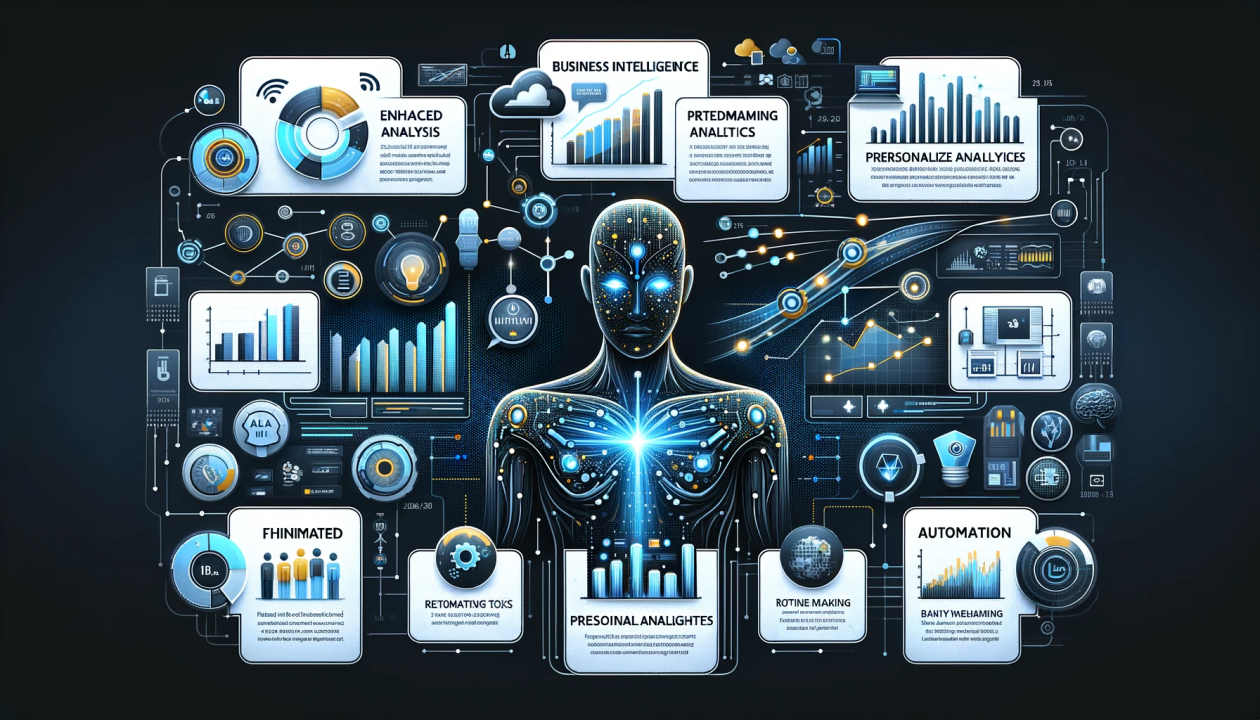
Photo by Mohamed Magdy El
Artificial Intelligence for Business: A Practical Guide to Smarter Growth
Artificial Intelligence for Business has moved from being a futuristic concept to a practical business tool. Companies of all sizes are using AI to automate repetitive work, understand customers, improve marketing, analyze data, and make faster decisions.
For entrepreneurs and small businesses, AI can be particularly valuable because it can help smaller teams accomplish tasks that once required significant time, money, or specialized expertise. A local retailer, for example, can use AI to analyze sales patterns, create marketing content, answer common customer questions, and identify products that may need restocking.
However, adopting AI is not simply about buying the latest AI tool. Successful implementation requires a clear business objective, reliable data, human oversight, and responsible use.
The real opportunity is not AI replacing business strategy. It is businesses using AI to execute strategy more intelligently, efficiently, and consistently.
What Is Artificial Intelligence for Business?
Artificial Intelligence for Business refers to the use of AI technologies to perform or support business activities that traditionally require human intelligence.
These technologies can help organizations:
- Analyze large amounts of information
- Automate repetitive processes
- Generate and organize content
- Predict customer behavior
- Improve customer support
- Identify business opportunities
- Support financial analysis
- Personalize marketing campaigns
- Assist employees with everyday tasks
AI can include technologies such as machine learning, natural language processing, generative AI, computer vision, and predictive analytics.
The important point is that AI should solve a specific business problem rather than being adopted simply because it is popular.
Why AI Matters for Modern Businesses
Businesses operate in an environment where customers expect faster service, employees face increasing workloads, and competition is becoming more data-driven.
AI can address several of these challenges.
1. Improved Productivity
AI can handle repetitive activities such as:
- Drafting routine emails
- Summarizing documents
- Creating reports
- Organizing information
- Generating initial content
- Answering frequently asked questions
This allows employees to spend more time on strategy, creativity, relationships, and problem-solving.
2. Better Decision-Making
Business decisions increasingly depend on data.
AI can analyze sales, customer behavior, operational information, and market trends to identify patterns that may not be immediately visible.
For example, an online retailer could analyze purchasing behavior and discover that customers who buy one product frequently purchase another. The company could then create a targeted product recommendation.
3. More Personalized Marketing
AI can help businesses understand different customer segments and deliver more relevant messages.
Marketing teams can use AI to support:
- Customer segmentation
- Campaign ideas
- Content creation
- Email personalization
- Advertising analysis
- Lead scoring
- Customer journey analysis
The final marketing strategy should still be guided by human judgment and brand positioning.
How Different Businesses Can Use AI
AI does not have a single application. Its value depends on the organization’s industry, size, customers, and operational needs.
Small Businesses
Small businesses can use AI for:
- Social media content planning
- Customer support
- Inventory analysis
- Basic bookkeeping assistance
- Market research
- Email drafting
- Sales forecasting
For example, a small clothing retailer could analyze historical sales data to identify seasonal demand and improve inventory planning.
Startups
Startups can use AI to accelerate operations without immediately building large teams.
Potential applications include:
- Market research
- Customer feedback analysis
- Product development
- Sales automation
- Lead qualification
- Business intelligence
Marketing Teams
Marketing professionals can use AI to analyze campaign performance, generate content drafts, identify audience segments, and develop creative variations.
AI should support marketing expertise—not replace positioning, creativity, or customer understanding.
Freelancers and Professionals
Freelancers can use AI to reduce administrative workload.
Examples include:
- Proposal preparation
- Research
- Meeting summaries
- Content drafts
- Client communication
- Project documentation
Practical Examples of AI in Business
AI-Powered Customer Service
Businesses can deploy AI-powered chatbots to answer common questions about products, pricing, delivery, availability, and policies.
A human employee can then handle complex or sensitive situations.
This creates a hybrid customer-service model where AI handles routine queries while people focus on cases requiring judgment.
AI for Sales
AI can help sales teams prioritize leads based on customer behavior and available business data.
Instead of treating every lead equally, a sales team can focus its attention on prospects showing stronger purchase intent.
AI for Finance
AI-assisted analytics can help businesses examine:
- Revenue trends
- Expenses
- Cash-flow patterns
- Customer payment behavior
- Budget performance
However, financial decisions should be reviewed by qualified professionals where appropriate.
AI for Inventory Management
A business can analyze historical sales, seasonal patterns, and product movement to improve inventory planning.
For a grocery retailer, this could help identify products that regularly experience higher demand during festivals or specific seasons.
How to Implement AI in Your Business
AI adoption should be approached as a business transformation project rather than a technology experiment.
Step 1: Identify a Business Problem
Start with a problem, not a tool.
Ask:
- What takes employees too much time?
- Where are customers experiencing delays?
- Which processes contain repetitive work?
- What decisions require better data?
- Where are errors occurring frequently?
Step 2: Prioritize High-Value Use Cases
Evaluate potential AI projects based on:
- Business impact
- Cost
- Implementation difficulty
- Data availability
- Risk
- Expected return
Start with a manageable use case that can demonstrate measurable value.
Step 3: Choose the Right AI Solution
Different problems require different technologies.
A business might need:
- Generative AI
- Predictive analytics
- AI-powered automation
- Customer-service tools
- Recommendation systems
- Business intelligence platforms
The most expensive solution is not necessarily the best solution.
Step 4: Prepare Your Data
AI is heavily dependent on data quality.
Businesses should establish processes for:
- Data accuracy
- Data security
- Access control
- Data organization
- Privacy
- Regular data maintenance
Poor-quality data can produce unreliable results.
Step 5: Keep Humans in the Loop
AI-generated outputs should be reviewed when accuracy, reputation, finances, compliance, or customer relationships are involved.
Human oversight remains essential.
Step 6: Measure Results
Define measurable objectives before implementation.
Useful metrics can include:
- Time saved
- Cost reduction
- Conversion rate
- Customer satisfaction
- Response time
- Revenue per employee
- Error reduction
If an AI initiative cannot demonstrate meaningful business value, reconsider its implementation.
Best Practices for Artificial Intelligence in Business
Businesses should consider the following principles when adopting AI:
- Start small: Test one meaningful use case first.
- Set clear objectives: Define what success looks like.
- Protect data: Avoid unnecessary exposure of confidential information.
- Maintain human oversight: Review important AI-generated decisions.
- Train employees: Teach teams how to use AI effectively.
- Document processes: Establish clear AI usage guidelines.
- Monitor performance: Regularly evaluate accuracy and business outcomes.
- Consider ethics: Address bias, privacy, transparency, and accountability.
- Integrate with workflows: AI should fit existing business processes.
- Focus on ROI: Technology adoption should create measurable value.
Common Mistakes Businesses Should Avoid
Using AI Without a Clear Objective
Adopting AI simply because competitors are doing so can waste resources.
Relying Completely on AI-Generated Content
AI-generated information can contain errors or lack the organization’s unique perspective.
Human review is essential for important business communication.
Ignoring Data Privacy
Sensitive customer, employee, financial, or proprietary information should not be entered into AI systems without understanding how that information is handled.
Automating a Bad Process
AI cannot automatically fix a fundamentally inefficient workflow.
Businesses should first understand and improve the process.
Measuring Activity Instead of Results
Generating hundreds of pieces of content does not necessarily mean marketing performance has improved.
Measure business outcomes, not merely AI usage.
The Future of AI and Business
AI is likely to become increasingly embedded in everyday business operations.
Instead of being treated as a separate technology, AI will increasingly become part of:
- Business intelligence
- Marketing platforms
- Customer relationship management
- Financial analysis
- Human-resource workflows
- Supply-chain management
- Productivity software
- Strategic decision-making
The competitive advantage will not necessarily belong to businesses using the most AI.
It will belong to businesses that integrate AI effectively with people, processes, data, and strategy.
Frequently Asked Questions
1. What is Artificial Intelligence for Business?
Artificial Intelligence for Business means applying AI technologies to improve business processes, decision-making, customer experiences, productivity, and growth.
2. Can small businesses benefit from AI?
Yes. Small businesses can use AI for marketing, customer service, research, administrative work, sales support, and data analysis without necessarily making major technology investments.
3. Can AI replace employees?
AI can automate certain tasks, but many business activities require judgment, creativity, communication, leadership, and accountability. In many cases, AI is more useful as an employee-support technology.
4. How can startups use AI?
Startups can use AI for market research, customer analysis, content creation, sales support, product development, automation, and operational efficiency.
5. Is AI expensive for businesses?
Costs vary significantly depending on the technology and implementation. Many businesses can begin with affordable AI tools and gradually invest in more advanced solutions as their needs grow.
6. What are the biggest risks of using AI?
Major risks include inaccurate outputs, data privacy problems, cybersecurity concerns, biased results, excessive automation, and insufficient human oversight.
7. How should a business start its AI journey?
Start by identifying one repetitive or data-intensive business problem, select an appropriate solution, test it on a small scale, measure the results, and expand only after demonstrating value.
Conclusion
Artificial Intelligence for Business is no longer limited to large technology companies. Entrepreneurs, startups, retailers, professional firms, marketing teams, and established organizations can all use AI to improve how they operate.
The most effective approach is strategic rather than experimental. Businesses should identify genuine problems, select appropriate technologies, protect their data, train employees, maintain human oversight, and measure measurable outcomes.
AI can improve productivity and decision-making, but technology alone does not create sustainable competitive advantage. Business strategy, customer understanding, strong execution, and responsible technology adoption must work together.
For organizations willing to approach AI thoughtfully, the opportunity is significant: fewer repetitive tasks, better use of data, stronger customer experiences, and more scalable business operations.
Call to Action
At Pinehills Business Solutions, we help businesses explore practical opportunities across business consulting, branding, marketing, digital transformation, AI solutions, and business growth.
Whether you are a startup founder exploring AI, a small business looking to automate operations, or an established organization planning digital transformation, the right strategy can turn technology into measurable business value.
Connect with Pinehills Business Solutions to explore how AI and digital strategies can support your next stage of growth.