
The State of Customer Journey Mapping: How to Align Sales and Marketing for Maximum ROI
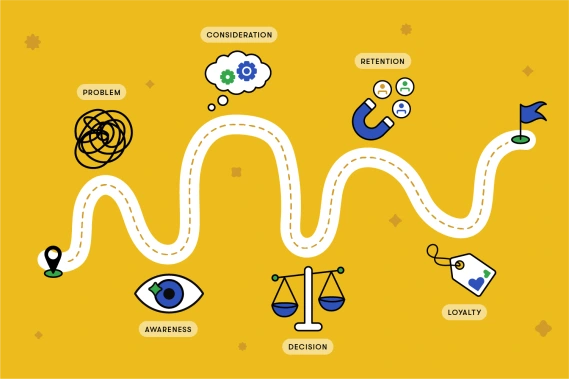
Photo by Sara Eden
The State of Customer Journey Mapping: How to Align Sales and Marketing for Maximum ROI
The modern B2B buying process has become significantly more complex. Today’s business buyers rarely follow a straightforward path from discovering a product to making a purchase. Instead, they move between digital channels, consult industry experts, compare competing solutions, evaluate financial implications, and seek approval from multiple organizational stakeholders before committing to a vendor.
For businesses operating in competitive markets, understanding this behavior is essential. Traditional marketing strategies that focus exclusively on generating leads and traditional sales approaches centered on closing individual opportunities are no longer sufficient.
This is where customer journey mapping becomes a strategic advantage.
Customer journey mapping provides organizations with a structured understanding of how potential customers discover, evaluate, purchase, and ultimately interact with their products or services. More importantly, it creates an opportunity to align sales and marketing around shared customer expectations, measurable business objectives, and revenue outcomes.
When these departments operate together rather than independently, businesses can improve lead quality, reduce friction throughout the buying process, increase conversion rates, and generate stronger returns on their marketing investments.
In this article, we explore the current state of customer journey mapping, changing B2B buyer behavior, and the strategies organizations can implement to align sales and marketing for maximum ROI.
Understanding the Modern B2B Customer Journey
The traditional B2B customer journey was often represented as a linear funnel:
-
Awareness
-
Consideration
-
Decision
-
Purchase
-
Retention
Although these stages remain useful, they no longer accurately represent every buyer’s experience.
Modern B2B customers frequently conduct independent research before contacting a sales representative. They might discover a business through search engines, explore its website, read third-party reviews, watch product demonstrations, consult colleagues, and compare alternatives before requesting a sales conversation.
According to Gartner’s June 2025 research, 61% of B2B buyers prefer an overall rep-free buying experience. However, buyers still value sales representatives when they need contextual guidance and assistance evaluating whether a solution fits their organization’s requirements.
This indicates that businesses must provide both convenient digital experiences and meaningful human interactions.
Another important development is the growing influence of buying committees. Forrester’s 2026 research highlights that the typical B2B buying decision involves approximately 13 internal stakeholders and nine external influencers.
Consequently, businesses are no longer marketing to a single decision-maker. They are engaging an interconnected group of individuals with different priorities, responsibilities, and expectations.
An effective customer journey map must therefore account for the entire buying group rather than focusing exclusively on the person who initially submits a contact form.
The Changing Behavior of Modern B2B Buyers
Understanding buyer behavior is the foundation of effective journey mapping. Several important developments are reshaping how organizations evaluate potential suppliers.
A. Independent Research Comes First
B2B buyers increasingly prefer to educate themselves before interacting with sales teams.
They use search engines, educational resources, comparison websites, industry publications, professional communities, and AI-powered research tools to understand available solutions.
This creates an important challenge for marketers: influencing purchasing decisions before prospects become identifiable leads.
Businesses must therefore invest in educational content that addresses customer questions, explains industry challenges, and demonstrates their expertise.
B. Buying Decisions Involve Multiple Stakeholders
A B2B purchase often requires agreement between departments such as finance, procurement, operations, IT, and senior management.
Each stakeholder evaluates the proposed solution differently.
For example:
-
Finance teams prioritize costs, budgets, and financial returns.
-
IT departments examine security, integration, and technical compatibility.
-
Operations teams evaluate efficiency and implementation requirements.
-
Senior executives focus on strategic outcomes and long-term business value.
-
Procurement teams assess pricing, contractual conditions, and supplier reliability.
Customer journey mapping should identify these different perspectives and ensure that relevant information is available to each stakeholder.
C. Buyers Expect Personalized Experiences
Generic marketing messages are becoming less effective.
Modern B2B buyers expect businesses to understand their industries, organizational challenges, and specific requirements.
Personalization should extend beyond using a prospect’s name in an email. It should involve delivering relevant case studies, product information, educational materials, and recommendations based on the buyer’s actual needs.
D. AI Is Changing the Research Process
Artificial intelligence is influencing how buyers discover information, compare vendors, and evaluate potential solutions.
AI-powered search experiences and generative AI tools allow buyers to investigate complicated business problems more efficiently.
For marketers, this creates a need to produce authoritative, well-structured, and genuinely useful content that demonstrates subject-matter expertise.
Businesses must also maintain accurate and consistent information across their websites, sales materials, and other digital channels.
The Current State of Customer Journey Mapping
Customer journey mapping is evolving from a marketing visualization exercise into a broader revenue management strategy.
Historically, marketing teams primarily used journey maps to understand how prospects interacted with campaigns, landing pages, advertisements, and email sequences.
Sales teams, meanwhile, focused on conversations, negotiations, objections, and closing opportunities.
The problem was that both departments frequently worked with different information and performance indicators.
Modern organizations are moving toward integrated journey mapping that combines marketing engagement, sales interactions, customer feedback, account intelligence, and post-purchase experiences.
Research from 6sense’s 2026 B2B Buyer Experience Report reinforces the importance of this shift. Its findings indicate that B2B buying groups typically spend approximately 60% of their purchasing journey in the selection phase, making decisions and developing vendor preferences before moving into direct seller engagement.
This has significant implications for businesses.
If marketing only measures success through form submissions and sales only measures performance through opportunities already in the pipeline, both departments risk overlooking the most influential part of the buying journey.
An effective journey map must therefore capture:
-
How customers identify business challenges.
-
Where they research potential solutions.
-
Which channels influence their opinions.
-
How buying groups compare vendors.
-
What information they need before contacting sales.
-
Which objections prevent purchasing decisions.
-
What experiences influence retention and expansion.
The objective is not simply to document customer interactions. It is to understand what customers are trying to accomplish at every stage and remove barriers that prevent them from progressing.
Why Sales and Marketing Alignment Is Critical for Maximum ROI
Sales and marketing alignment, often called Smarketing, refers to the coordination of both departments around common revenue objectives.
Without alignment, businesses frequently experience duplicated efforts, inconsistent messaging, poor lead quality, delayed follow-ups, and missed opportunities.
Consider a situation in which marketing generates hundreds of leads through a campaign. However, the sales department discovers that most prospects lack the budget, authority, or immediate requirement to purchase.
Marketing may consider the campaign successful because it generated substantial engagement. Sales may consider it unsuccessful because it produced few qualified opportunities.
This disconnect creates unnecessary costs and reduces marketing ROI.
Customer journey mapping helps solve this problem by establishing a shared understanding of customer expectations and conversion requirements.
Four Areas Where Alignment Creates Value
1. Consistent Messaging
Marketing campaigns and sales conversations should communicate the same value proposition.
When prospects receive conflicting information about pricing, product capabilities, implementation, or expected outcomes, trust can deteriorate.
Gartner’s 2025 research found that 69% of B2B buyers reported inconsistencies between information provided on supplier websites and information communicated by sales representatives.
A unified messaging strategy helps eliminate this problem.
2. Better Lead Qualification
Marketing and sales should jointly define what constitutes a qualified lead.
This includes agreeing on ideal customer profiles, industry relevance, organizational requirements, buying intent, and readiness to engage.
Shared qualification criteria help sales teams prioritize opportunities with greater revenue potential.
3. Faster Sales Follow-Up
When marketing identifies meaningful buying signals, sales representatives can respond with relevant information rather than generic outreach.
Shared customer data also helps sales teams understand previous interactions and avoid repeating conversations that prospects have already completed.
4. Improved Revenue Accountability
Both departments should be evaluated using metrics connected to business performance.
Instead of focusing exclusively on marketing-generated leads or sales activity, organizations should measure pipeline contribution, conversion rates, acquisition costs, revenue growth, and customer lifetime value.
How to Build an Effective B2B Customer Journey Map
Creating an effective customer journey map requires collaboration, reliable data, and a clear understanding of the target audience.
The following framework provides a practical starting point.
Step 1: Define Your Ideal Customer Profile
Begin by identifying the organizations most likely to benefit from your products or services.
Consider:
-
Industry and company size.
-
Annual revenue and purchasing capacity.
-
Business challenges and operational requirements.
-
Technology infrastructure.
-
Decision-making structure.
-
Geographic market.
Develop buyer personas for the important stakeholders within these organizations.
This allows marketing and sales to concentrate on relevant accounts instead of pursuing every available lead.
Step 2: Identify Every Important Touchpoint
Document how potential customers interact with your organization.
Common touchpoints include:
-
Search engine results.
-
Company websites and landing pages.
-
Social media platforms.
-
Industry events and webinars.
-
Email marketing campaigns.
-
Product demonstrations.
-
Sales consultations.
-
Customer reviews and testimonials.
-
Proposal presentations.
Identify which channels influence purchasing decisions and where customers encounter unnecessary friction.
Step 3: Map Buyer Needs Across Different Stages
Organize the journey around the tasks buyers need to complete.
Awareness: Buyers recognize a problem or business opportunity. Marketing provides educational content, industry insights, and practical resources.
Research and Consideration: Buyers investigate potential solutions, compare alternatives, and evaluate business requirements. Marketing supplies comparison guides, case studies, and detailed product information.
Evaluation and Validation: Buying groups examine technical compatibility, financial value, implementation risks, and vendor credibility. Sales representatives provide consultations, demonstrations, and tailored business cases.
Decision and Purchase: Buyers finalize internal approvals, negotiate commercial terms, and select a supplier. Sales coordinates proposals, negotiations, and purchasing requirements.
Retention and Expansion: Customers evaluate whether the solution delivers the expected results. Customer success teams provide onboarding, support, performance reviews, and opportunities for additional value.
Remember that these stages are not always linear. Buyers may revisit earlier activities whenever new questions or internal objections arise.
Step 4: Connect Sales and Marketing Data
An effective journey map requires a shared source of customer intelligence.
CRM platforms, marketing automation systems, website analytics, and customer feedback tools can provide valuable information about buyer behavior.
Integrating these systems helps organizations understand how marketing engagement influences sales outcomes.
For example, a sales representative should be able to understand which educational resources an account has accessed, which campaigns generated engagement, and what information has already been provided.
This creates a more informed and productive sales conversation.
Step 5: Identify Gaps and Optimize Continuously
Customer journey mapping should be treated as an ongoing process.
Regularly examine conversion data, customer feedback, sales objections, abandoned opportunities, and campaign performance.
If prospects repeatedly request information that is missing from your website, marketing should address that content gap.
If sales representatives encounter the same objections during demonstrations, both departments should develop better educational materials and supporting evidence.
Continuous improvement ensures that the journey map remains relevant as buyer expectations evolve.
Measuring Customer Journey Performance and Marketing ROI
A well-designed customer journey map should produce measurable business improvements.
Organizations must move beyond vanity metrics such as impressions, website visits, and social media engagement to understand how customer interactions contribute to revenue.
Important performance indicators include:
| KPI | What It Measures |
|---|---|
| Lead-to-Customer Conversion Rate | Percentage of leads that become customers |
| Customer Acquisition Cost (CAC) | Average cost of acquiring a new customer |
| Marketing-Sourced Pipeline | Pipeline generated through marketing activities |
| Sales Cycle Length | Time required to convert an opportunity |
| Customer Lifetime Value (CLV) | Expected revenue generated throughout a customer relationship |
| Customer Retention Rate | Percentage of customers retained over a given period |
| Pipeline Velocity | Speed at which qualified opportunities generate revenue |
Businesses should also examine conversion rates between individual journey stages to identify bottlenecks.
For example, if many prospects request product demonstrations but relatively few progress to proposals, the problem may involve product positioning, qualification, pricing, or the quality of the demonstration.
A useful starting point for calculating marketing ROI is:
Marketing ROI = [(Revenue Attributable to Marketing − Marketing Investment) ÷ Marketing Investment] × 100
However, B2B purchasing decisions involve multiple channels and interactions. Organizations should therefore use appropriate attribution models and distinguish between marketing-sourced revenue, marketing-influenced revenue, and broader sales contributions.
This provides a more realistic understanding of marketing’s impact.
The Role of AI and Automation in Customer Journey Optimization
Artificial intelligence and marketing automation are making customer journey mapping more sophisticated.
Modern platforms can analyze customer interactions, identify patterns, prioritize accounts, and support personalized communication.
Several applications are particularly valuable.
Predictive Lead Scoring: AI models can analyze historical customer and engagement data to identify prospects with characteristics associated with successful conversions.
Behavioral Analysis: Businesses can identify patterns in website visits, content consumption, and account engagement to better understand customer interests.
Personalized Communication: Automation platforms can deliver relevant messages based on customer industry, role, interests, and previous interactions.
Sales Intelligence: AI-assisted tools can summarize account activity, organize customer information, and help sales representatives prepare for conversations.
Journey Analytics: Advanced analytics can identify conversion bottlenecks and reveal which touchpoints contribute to successful customer outcomes.
Nevertheless, automation should complement human judgment rather than replace meaningful customer relationships.
B2B buyers still need knowledgeable professionals who can address complex requirements, explain commercial implications, and build confidence in important purchasing decisions.
Common Customer Journey Mapping Mistakes to Avoid
Even organizations with sophisticated marketing technology can struggle to create effective customer journeys.
Some common mistakes include:
-
Treating the journey as linear: Buyers frequently move between stages, channels, and information sources.
-
Ignoring the buying committee: Focusing exclusively on one decision-maker overlooks the concerns of other influential stakeholders.
-
Prioritizing lead volume over quality: Generating more leads does not automatically produce more revenue.
-
Using disconnected data: Separate sales and marketing systems create incomplete customer profiles.
-
Overusing automation: Excessive or irrelevant communication can damage customer relationships.
-
Failing to measure outcomes: Journey mapping must connect customer experience improvements to measurable business results.
Avoiding these mistakes helps businesses create more realistic journey maps and build stronger relationships with potential customers.
Conclusion: Turning Customer Insights Into Sustainable Revenue Growth
Customer journey mapping has become an essential component of modern B2B growth strategies.
As buyers become more independent, buying committees expand, and digital research becomes increasingly sophisticated, businesses must rethink how they approach customer engagement.
The most successful organizations will be those that understand the entire buying process rather than concentrating exclusively on lead generation or sales conversion.
Aligning sales and marketing around shared customer insights creates a more consistent experience, improves lead qualification, reduces unnecessary friction, and strengthens revenue accountability.
Technology, AI, and automation can further improve this process, but their effectiveness ultimately depends on accurate data, coordinated teams, and a genuine understanding of customer needs.
For businesses seeking sustainable growth, the objective should be straightforward: make every customer interaction more relevant, every internal team more aligned, and every stage of the buying journey more effective.
When customer journey mapping becomes a shared business strategy rather than an isolated marketing exercise, organizations are better positioned to build lasting customer relationships and maximize their return on investment.