
Business Case Study on Adani Ports & SEZ: A Timeless Example of Vision, Trust, and Business Growth Strategy
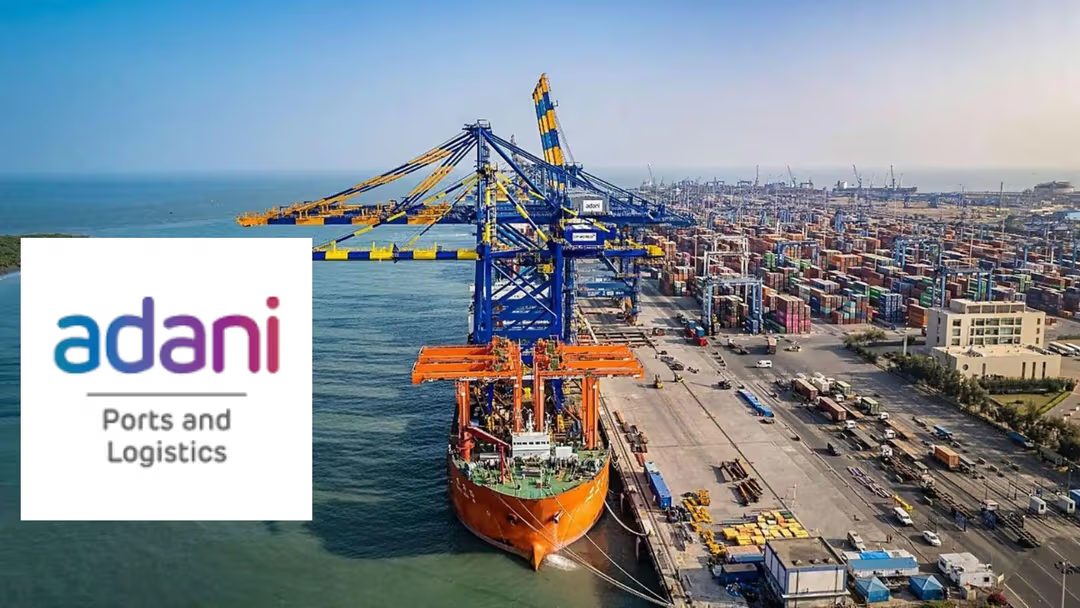
Photo by Ganesh K
Business Case Study on Adani Ports & SEZ: A Timeless Example of Vision, Trust, and Business Growth Strategy
Introduction: Why This Business Case Study Matters
In today’s competitive global economy, infrastructure companies rarely become household names. Yet Adani Ports and Special Economic Zone Limited (APSEZ) has done exactly that—emerging as India’s largest private port operator and a global logistics powerhouse. This business case study explores how a bold vision, strategic execution, and calculated risk-taking transformed a single port into a nationwide logistics network.
For entrepreneurs, students, and business leaders, this case reveals powerful lessons in business growth strategy, marketing strategy, and branding success. At Pinehills Business Solutions, we believe such real-world examples are essential for understanding how Indian companies scale from local players to global giants.
Company Background: From Humble Beginnings to National Dominance
Founder Story
The journey begins with Gautam Adani, a first-generation entrepreneur from Gujarat. Starting as a commodity trader, Adani had no formal legacy business backing him. What he did have was vision—the ability to identify future demand before others.
Establishment and Early Days
- Founded in 1998
- Headquarters: Ahmedabad, Gujarat
- First major asset: Mundra Port
Mundra was not just a port—it was a strategic gamble. At the time, India’s port infrastructure was dominated by government entities, and private participation was limited.
Initial Challenges
- Lack of trust in private port operators
- Heavy capital investment requirements
- Regulatory complexities
- Limited brand recognition
Despite these barriers, Adani’s vision was clear: build an integrated logistics ecosystem, not just a port.
Vision and Mission
- Create world-class port infrastructure in India
- Integrate logistics, transport, and supply chain
- Enable faster trade and economic growth
The Core Challenges: Growth, Competition, and Scale
Even after establishing Mundra Port, APSEZ faced several business challenges:
1. Competition Problem
Government-owned ports like Mumbai Port and Chennai Port had strong legacy advantages. Competing with them required differentiation.
2. Branding Problem
Ports are typically B2B businesses with low public visibility. Building a recognizable brand in this sector was difficult.
3. Financial Pressure
- High capital expenditure
- Long gestation periods
- Dependence on trade cycles
4. Growth Challenge
Scaling from one port to a nationwide network required:
- Land acquisition
- Infrastructure development
- Strategic partnerships
5. Management Complexity
Managing multiple ports across India required operational excellence and coordination at scale.
The Turning Point: Strategy That Changed Everything
APSEZ didn’t just grow—it scaled intelligently. The turning point came from a combination of bold strategies:
1. Integrated Business Strategy
Instead of operating as a standalone port, APSEZ built an ecosystem:
- Ports + logistics + rail + warehousing
- End-to-end supply chain solutions
This created strong customer dependency and loyalty.
2. Aggressive Expansion Strategy
APSEZ expanded through:
- Acquisitions of existing ports
- Development of new greenfield ports
- Entry into international markets
This reduced reliance on a single location and diversified revenue.
3. Customer-Centric Approach
Unlike traditional ports, APSEZ focused on:
- Faster cargo handling
- Reduced turnaround time
- Efficient logistics solutions
This became a key marketing strategy in a B2B environment.
4. Branding Strategy
Even in an industrial sector, APSEZ built a strong brand by:
- Positioning itself as India’s logistics backbone
- Associating with reliability and efficiency
- Leveraging the broader Adani Group brand
5. Innovation and Technology
- Digital tracking systems
- Automation in cargo handling
- Data-driven logistics management
This improved operational efficiency and reduced costs.
6. Leadership Decisions
Gautam Adani’s leadership style played a crucial role:
- Long-term vision over short-term profits
- High-risk, high-reward investments
- Quick decision-making
7. Public Listing and Financial Strategy
Listing on the stock market helped:
- Raise capital
- Build investor trust
- Fund expansion plans
Results: Measurable Business Impact
The strategies delivered powerful results:
Revenue Growth
- Consistent increase in revenue year-on-year
- Strong EBITDA margins compared to competitors
Market Leadership
- India’s largest private port operator
- Handles a significant portion of India’s cargo
Expansion
- Multiple ports across India
- Presence in international markets
Brand Recognition
- Recognized as a key player in India’s infrastructure sector
- Strong association with reliability and scale
Customer Growth
- Major global clients
- Long-term contracts ensuring stable revenue
Digital Growth
- Improved operational visibility
- Enhanced customer experience through technology
This is a classic example of branding success combined with operational excellence.
Pinehills Business Solutions Analysis: Key Lessons for Businesses
At Pinehills Business Solutions, we analyze such case studies to extract actionable insights for Indian entrepreneurs and businesses.
1. Think Beyond the Product
APSEZ didn’t just build ports—it built a system.
Lesson: Offer complete solutions, not just services.
2. Scale Strategically
Expansion was not random—it was planned.
Lesson: Grow with a clear roadmap.
3. Invest in Infrastructure and Technology
Efficiency became their competitive advantage.
Lesson: Technology is a growth multiplier.
4. Branding Matters Even in B2B
APSEZ proved that branding is not just for consumer businesses.
Lesson: Build trust and recognition.
5. Take Calculated Risks
Mundra Port itself was a bold move.
Lesson: Growth requires risk-taking.
6. Avoid Common Mistakes
- Expanding without strategy
- Ignoring customer experience
- Underestimating competition
7. Business Tips for Startups
- Start small but think big
- Focus on long-term value
- Build strong networks and partnerships
For Indian entrepreneurs, this case highlights the power of vision combined with execution.
The Human Side: Grit, Risk, and Determination
Behind every large business is a human story.
Gautam Adani’s journey reflects:
- Starting from scratch
- Facing financial uncertainty
- Taking bold decisions under pressure
Building Mundra Port was not just a business move—it was a leap of faith. The risks were enormous, but so were the rewards.
This reminds us that every successful business story includes:
- Sleepless nights
- Tough decisions
- Failures and learnings
Success doesn’t happen overnight—it is built through persistence and hard work.
Conclusion: Turning Vision into Reality
The story of Adani Ports & SEZ is more than just a corporate success—it is a blueprint for business growth strategy in India. From a single port to a global logistics leader, the company demonstrates how vision, strategy, and execution can create extraordinary results.
For businesses looking to grow, this case study offers clear insights into:
- Scaling operations
- Building strong brands
- Creating long-term value
Call to Action: Grow Your Business with Pinehills Business Solutions
If you are inspired by this business case study and want to achieve similar growth, Pinehills Business Solutions is here to help.
We specialize in:
- Business consulting India
- Marketing strategy and branding
- Growth strategy for startups and enterprises
- School and college projects
- Event management solutions
Let us help you turn your business vision into reality.
Contact Pinehills Business Solutions today and take the first step toward success.