
Business Registration Process in India: A Complete Step-by-Step Guide for Entrepreneurs (2026)
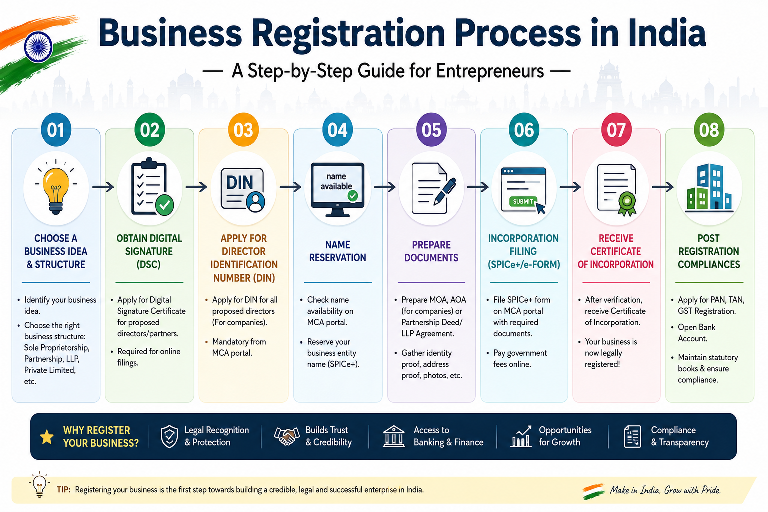
Photo by Chatgpt
Business Registration Process in India: A Complete Step-by-Step Guide for Entrepreneurs (2026)
Starting a business is an exciting milestone, but turning an idea into a legally recognized enterprise requires more than passion and planning. One of the most important steps is completing the business registration process in India. Registering your business not only establishes its legal identity but also builds trust with customers, investors, suppliers, and financial institutions.
Whether you are launching a startup, opening a retail store, starting a consultancy, or building an online business, choosing the right business structure and completing the required registrations can save you from legal complications in the future. A registered business also enjoys greater access to funding, government schemes, tax benefits, and business partnerships.
This guide explains the complete business registration process in India in a simple, practical, and easy-to-understand manner. By the end, you will know which business structure suits your needs, the documents required, and the steps to legally establish your business.
Why Business Registration Matters
Business registration is more than a legal requirement—it is the foundation of a successful enterprise. Registering your business provides several long-term advantages.
Some of the key benefits include:
- Establishes legal recognition.
- Builds credibility with customers and investors.
- Simplifies opening a business bank account.
- Makes it easier to obtain loans and investment.
- Enables participation in government tenders.
- Protects your business name and brand identity.
- Ensures compliance with Indian laws and regulations.
For example, many corporate clients prefer working only with registered businesses because it reflects professionalism and accountability.
Understanding Different Business Structures in India
Selecting the right business structure is one of the most important decisions before registration. Each structure has different legal, financial, and tax implications.
1. Sole Proprietorship
A Sole Proprietorship is owned and managed by one individual.
Suitable For
- Freelancers
- Small retailers
- Local service providers
- Home-based businesses
Advantages
- Easy to start
- Low compliance requirements
- Full control over business decisions
- Minimal registration costs
Limitations
- Unlimited personal liability
- Difficult to raise investment
- Limited business continuity
Example: A local digital marketing consultant operating independently.
2. Partnership Firm
A Partnership Firm is formed when two or more individuals jointly own and operate a business.
Suitable For
- Family businesses
- Professional firms
- Small trading businesses
Advantages
- Shared responsibilities
- Combined expertise
- Relatively simple setup
Limitations
- Shared liability
- Potential disputes among partners
A well-drafted partnership deed is essential to clearly define roles, responsibilities, and profit-sharing arrangements.
3. Limited Liability Partnership (LLP)
An LLP combines the operational flexibility of a partnership with the limited liability protection of a company.
Suitable For
- Consulting firms
- Professional services
- Agencies
- Growing startups
Advantages
- Limited liability protection
- Separate legal identity
- Lower compliance than private limited companies
4. Private Limited Company
A Private Limited Company is one of the most popular business structures for startups and rapidly growing businesses.
Suitable For
- Technology startups
- Manufacturing businesses
- Investors-backed companies
- Scalable businesses
Advantages
- Separate legal entity
- Limited liability
- Easier fundraising
- Strong brand credibility
Many successful Indian startups began as private limited companies because investors generally prefer this structure.
5. One Person Company (OPC)
An OPC allows a single entrepreneur to enjoy many benefits of a private limited company without requiring multiple shareholders.
Suitable For
- Solo entrepreneurs
- Independent professionals
- Business owners planning future expansion
Step-by-Step Business Registration Process in India
Although the exact process depends on the business structure, the following steps cover the standard registration journey for most businesses.
Step 1: Choose the Right Business Structure
Begin by identifying your business goals.
Consider:
- Number of owners
- Investment requirements
- Tax implications
- Future expansion plans
- Compliance responsibilities
Choosing the correct structure at the beginning can save significant time and costs later.
Step 2: Select a Unique Business Name
Your business name should be:
- Unique
- Easy to remember
- Relevant to your industry
- Available for registration
- Suitable for domain name registration
Before finalizing the name, check whether similar company names or trademarks already exist. This helps avoid future legal disputes and strengthens your brand identity.
Step 3: Obtain Digital Signature Certificate (DSC)
For companies and LLPs, many registration forms are filed electronically. A Digital Signature Certificate (DSC) is required to digitally sign these documents.
A DSC improves security, authenticity, and efficiency during the registration process.
Step 4: Apply for Director Identification Number (DIN)
If you are registering a company, every proposed director must obtain a Director Identification Number (DIN).
The DIN acts as a unique identification number for company directors under Indian corporate law.
Step 5: Prepare Essential Documents
The documentation process varies depending on the chosen business structure. However, the following documents are commonly required:
Identity Proof
- Aadhaar Card
- PAN Card
- Passport (where applicable)
Address Proof
- Voter ID
- Driving Licence
- Passport
- Utility bill
Business Address Proof
- Electricity bill
- Rental agreement
- Property ownership documents
- No Objection Certificate (if applicable)
Additional Documents
- Passport-size photographs
- Email address
- Mobile number
- Bank details
- Partnership deed or incorporation documents (where applicable)
Preparing these documents in advance helps avoid delays during registration.